Kindle and paperback
Nobody sends a letter when you turn 18
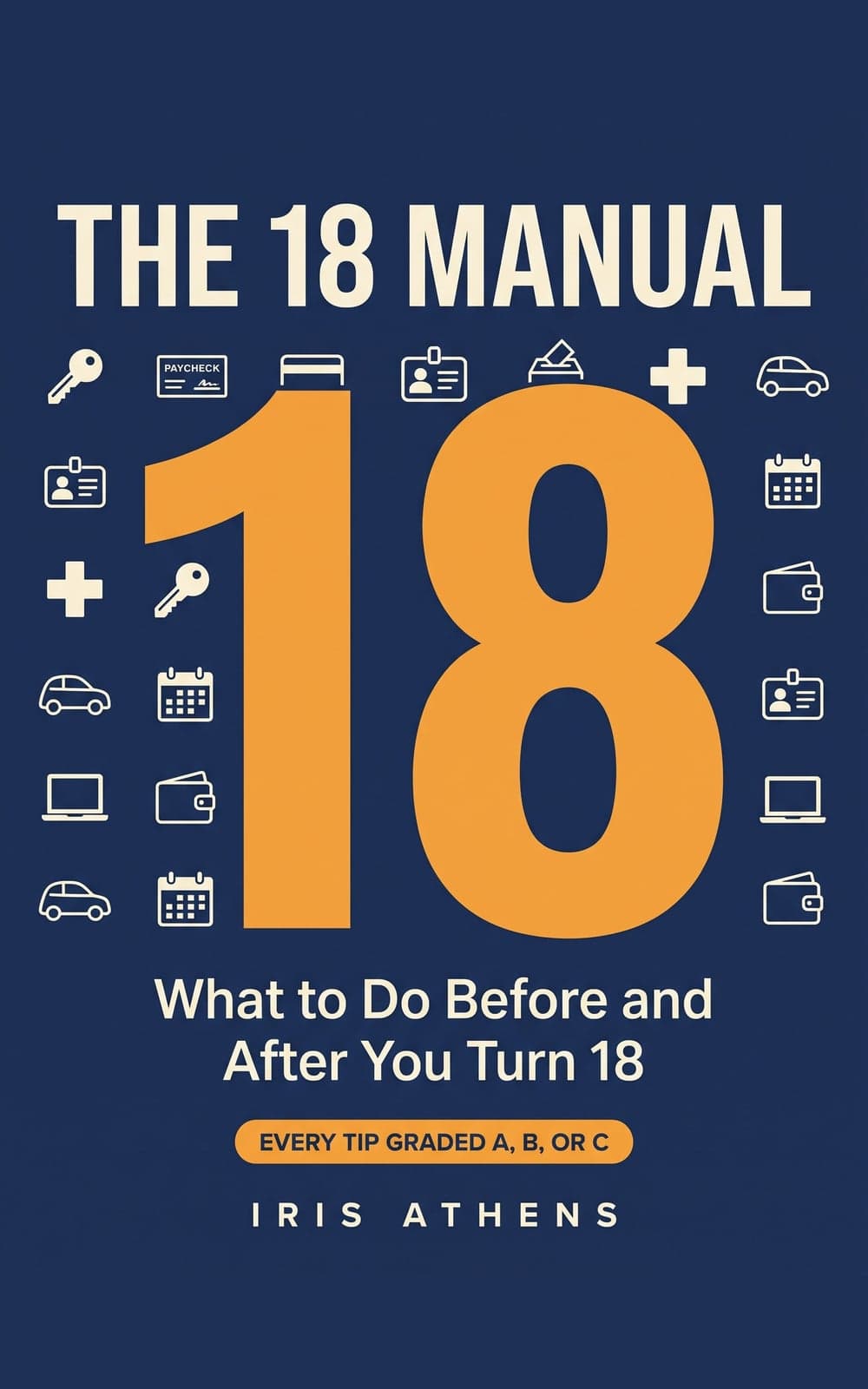
The 18 Manual is a guide by Iris Athens for readers 16 to 19 in the United States. It covers about 130 grown-up moves, from voting and Selective Service to pay stubs, leases, health insurance and scams. Each move lists what it costs, what it pays back and an A, B or C grade for how strong the proof is.
The 18 Manual. What to Do Before and After You Turn 18: Money, Work, Rent, Health, and Your Legal Rights, Graded by What It Costs and How Well It Works
You turn 18 and the rules change overnight. You can sign a lease, be called for jury duty and be held to the contracts you sign. Nobody sends a letter explaining any of it. The first paycheck shows up with lines you don't recognize, and the first lease comes with words nobody taught you.
Most books for new adults are a long list of things you should do. The list is fine. The trouble is that it never says which items matter and which are just nice ideas. So everything feels equally urgent, and nothing gets done.
This book gives every move four short parts. Do this is the move in one sentence. Costs is what it takes in money, time and hassle. Pays back is what you get or what it saves you from. Proof is a grade from A to C. Saying no to overdraft coverage on a debit card is an A, because a federal rule says the bank can't charge that fee unless you opted in. Keeping your card balance under 30 percent of your limit is a C, because there is no official cutoff. Both are in the book. Only one of them is a rule.
Right after the opening, one page lists the Cheap A's: 17 moves that cost close to nothing and have the strongest proof. Register to vote. Pull your free credit reports. Freeze your credit at all three bureaus. Put your 26th birthday in your calendar, because that is when a parent's health plan can stop covering you. The book says it plainly: nobody does all of it. Do a few this month and you are already ahead.
Does any of this sound familiar?
- Your pay stub makes no senseThe book walks through the W-4, every line on a pay stub, when to file and how to file for free.
- Everyone gives you a different listEach move carries a grade, so you can tell a law from a nice idea.
- Your first lease is comingLeases, deposits and renters insurance, explained before you sign.
- A deal that asks for a strange kind of paymentThe payment methods only scammers demand, and the checks to run before buying a used car.
What is inside the book?
- 01The Cheap A'sOne page of free or nearly free moves backed by a law, an official rule or strong research.
- 02The week you turn 18Age of majority, voting, Selective Service, jury duty, REAL ID and the health care proxy most families forget.
- 03Money and creditOverdraft opt-out, a $500 starter emergency fund, free credit reports, credit freezes and why cosigning is a trap.
- 04Paychecks and taxesThe W-4, every line on a pay stub, when to file, filing for free and the 2026 numbers.
- 05Work, school and rentMinimum wage and overtime, the 2027-28 FAFSA, student loans, leases, deposits and renters insurance.
- 06HealthStaying on a parent's plan until 26, five insurance words, surprise bill rights, and when to use 911, the ER or urgent care.
- 07Scams, cars and legal red linesThe payment methods only scammers demand, used car checks, and the photo and threat laws that apply at 18.
What do you have when you finish?
A short list of moves you have actually made, starting with the cheap ones that have the strongest proof, and a clear idea of which advice is a rule and which is a guess. Every chapter ends with a Check Yourself page, and the source list at the back gives the item number for each rule, so you know where to look when something changes.
This book is for you if
- You are 16 to 19 and live in the United States.
- You are about to get a first paycheck, a first lease or a first insurance card.
- You want to know which grown-up advice is a law and which is just an opinion.
- You are looking for an 18th birthday or graduation gift that will actually get used.
This book is not for you if
- You live outside the US. The rules and agencies in it are American.
- You want personal legal, tax or medical advice. The book explains published rules and points to free, qualified help where it exists.
Questions before you buy
What age is The 18 Manual written for?
Readers 16 to 19. It works before the birthday, when a teen can pre-register to vote in many states and plan ahead, and in the year or two after, when the first paycheck, the first lease and the first insurance card show up.
What do the A, B and C grades mean?
A means a law, an official rule or strong research. B means official guidance from a government agency or a professional body, the standard advice. C means it makes sense and some evidence points that way, but the proof is thin. Every item also lists what it costs in money, time and hassle.
Is it a good 18th birthday or graduation gift?
It was written with that in mind. A short opening chapter, For the Grown-Up Who Gave You This, tells the giver what helps most: don't quiz them, be the person they call, and sit with them for an hour on the first chapter, because some steps, like the medical forms, need an adult's help to set up.
Does the book give legal, tax or medical advice?
No. It explains published US rules and where to check them, such as the IRS, the CFPB, the FTC and HealthCare.gov. For a personal case it points to free help like IRS free tax help and legal aid through LawHelp.org. Iris Athens is not a lawyer, accountant, doctor or financial adviser.
How current are the rules, and what format is it?
The sources were checked in October 2026, and yearly numbers carry their year. It is an English-language book of 142 pages, on Amazon Kindle for $5.99 and in paperback for $15.99.