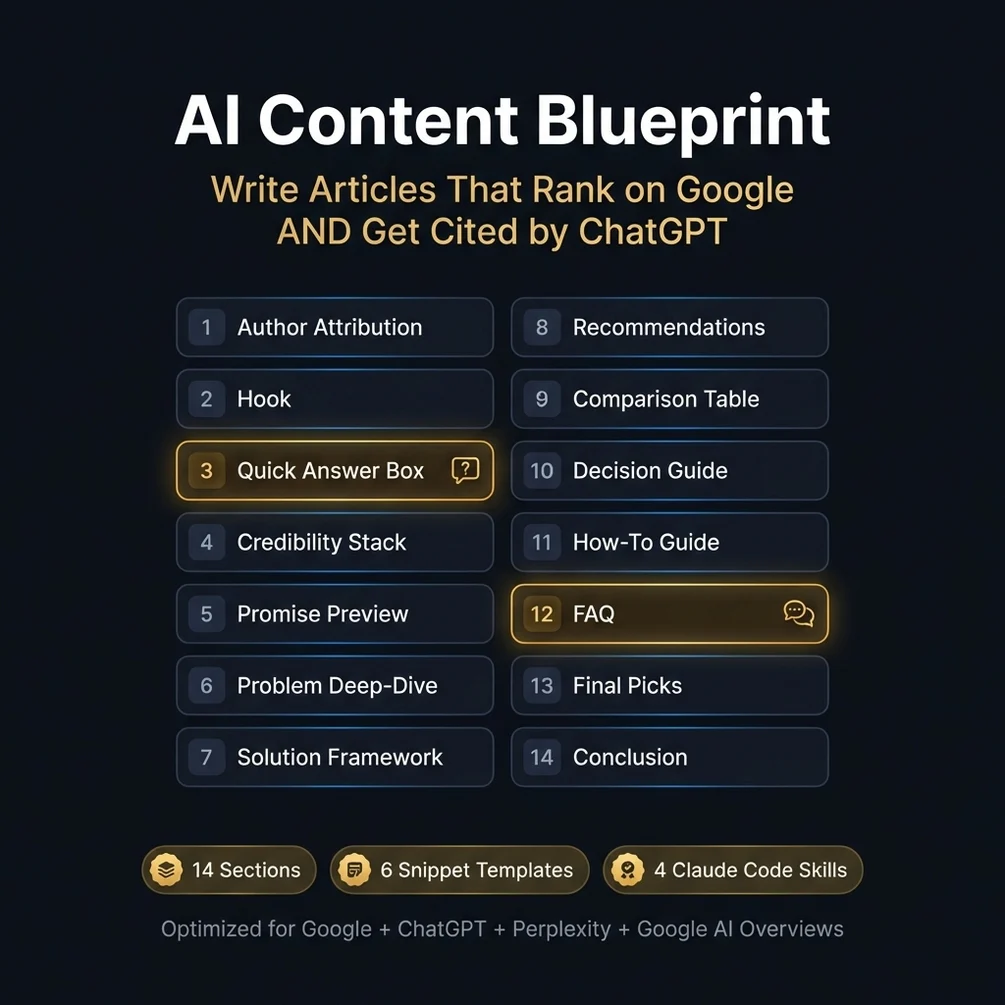
AI Content Blueprint
Write Articles That Rank on Google AND Get Cited by ChatGPT
What it is
A 14-section article framework + 6 Quick Answer Box templates + 4 Claude Code writing skills. Produces 2,200–2,600 word articles with 10–15 built-in AI citation opportunities per piece. $29 one-time.
- 14-section article blueprint (Markdown, fill-in-the-blanks)
- 6 Quick Answer Box templates for AI snippet extraction
- 4 Claude Code skills: blog-writer, article-writing, content-strategy, copy-editing
- Content quality checklist (length, headings, links, voice)
- Free lifetime updates via Gumroad
The problem
You're writing content that Google ignores and ChatGPT has never seen.
You spent hours on that article. You did keyword research. You followed every SEO checklist you could find. You hit publish. Nothing happened.
Google buried it on page 4. ChatGPT doesn't cite it. Perplexity doesn't know it exists. Your content is technically “live” — but functionally invisible.
Here's the brutal truth: the way most people write content in 2026 is broken.
Traditional SEO articles are written for an outdated algorithm. AI-generated content is generic filler that Google's Helpful Content system flags and suppresses. And neither approach is optimized for the new reality: AI search engines that give direct answers and cite their sources.
You need a framework that works for both worlds— Google rankings AND AI citations. That's exactly what this is.
The framework
The 14-Section Article Blueprint
Every article you write follows this proven structure — section by section, word count by word count.
Author Attribution
E-E-A-T signal — tells Google and AI you're a real expert
Hook (≤300 words)
Grabs attention, states the problem compellingly
Quick Answer Box
≤40 words — this is what ChatGPT and Perplexity cite
Credibility Stack
Why readers (and AI) should trust your recommendations
Promise Preview
3–5 bullet checklist of what the article delivers
Problem Deep-Dive
Quantifies the pain with specifics (250–300 words)
Solution Framework
Your proven approach that actually works (300–400 words)
Recommendations
4–7 detailed options with 200+ words each
Comparison Table
Side-by-side breakdown across key decision factors
Decision Guide
Checklist + common mistakes to avoid
How-To Guide
5–7 step-by-step actionable instructions
FAQ (10–15 Q&As)
Each one is a separate AI citation opportunity
Final Recommendations
Best Overall / Best Value / Premium Pick
Conclusion & Next Steps
Recap + action steps + freshness signal
Sections 3 and 12 are the AI citation engines. Section 3 (Quick Answer Box) is ≤40 words — the exact format AI systems prefer to quote. Section 12 (FAQ) gives you 10–15 separate citation opportunities in a single article.
The formula
The AI Citation Formula
Most creators don't know why ChatGPT cites some articles and ignores others. Here's the exact formula — baked into every section of the blueprint.
Quick Answer Box
A direct, factual answer in ≤40 words at the top of the article. AI systems extract this as a snippet.
FAQ Section
Each Q&A is a standalone citation opportunity. 15 FAQs = 15 chances to get quoted by AI.
Specific Numbers
"47% of users prefer..." gets cited. "Many users prefer..." does not.
Schema Markup
FAQPage + Article JSON-LD signals tell AI systems your content is structured and trustworthy.
SpeakableSpecification
Marks your Quick Answer Box as the preferred voice/citation excerpt for AI search engines.
Claude Code automation
4 Writing Skills Included
Already using Claude Code? These skills automate the entire framework. Don't use Claude Code? The templates work standalone.
/blog-writerCreates full SEO + GEO-optimized blog posts following the 14-section blueprint automatically
/article-writingWrites long-form articles, guides, and tutorials in any brand voice or niche
/content-strategyKeyword research, topic clustering, and content calendar planning in one command
/copy-editingReviews and improves drafts for clarity, structure, and conversion impact
Built-in standards
Professional Content Standards, Automatically
Word Count
2,200–2,600 words
The ranking + depth sweet spot
Paragraph Length
2–3 sentences max
Mobile-first readability
Internal Links
Minimum 15/article
Woven naturally throughout
External Citations
3+ authoritative sources
E-E-A-T trust signals
Headings
Action-oriented H2/H3
"Which Tool Works Best?" not "Tool Overview"
Voice
American English, "you"-focused
Specific over vague, always
Who it's for
Built for Serious Content Publishers
Content Creators
Publishing 2+ articles per week who want every piece to rank AND get cited by AI.
SEO Professionals
Who know rankings are only half the game — AI citations are the other half in 2026.
Agency Content Teams
Who need a repeatable framework that produces consistent quality at scale.
Affiliate Marketers
Writing review and comparison content — this is the Wirecutter-style structure that converts.
FAQ
Common Questions
Do I need Claude Code to use this?
No. The 14-section blueprint and Quick Answer Box templates are Markdown files that work with any writing tool — Word, Notion, Google Docs, or any CMS. Claude Code skills are optional for automation.
How long does it take to write one article using the framework?
Manually: 2–3 hours for a well-researched 2,400-word article. With Claude Code skills: 15–20 minutes for a full draft you then refine.
What makes the Quick Answer Box different from a regular introduction?
It's placed early, kept under 40 words, written as a direct factual statement, and marked with SpeakableSpecification schema — the exact format AI systems prefer to extract and cite.
Will this work for any niche?
Yes. The framework is topic-agnostic. It works for SaaS, finance, health, tech, B2B, affiliate, and any informational content where ranking and authority matter.
How is this different from generic AI content generators?
Generic prompts produce flat, unstructured content. This blueprint provides a section-by-section architecture with word counts, citation formulas, and E-E-A-T signals baked in — structure that AI generators don't know.
Does the framework handle internal linking?
Yes. The blueprint enforces a minimum of 15 internal links per article woven naturally throughout the content, with guidance on anchor text and placement strategy.
What's included in the download?
14-section article blueprint (Markdown), 6 Quick Answer Box templates, 4 Claude Code skills (blog-writer, article-writing, content-strategy, copy-editing), content quality checklist, and free lifetime updates.
Is the 2,200–2,600 word target flexible?
That's the sweet spot for ranking + depth. Shorter content misses key sections. Longer risks padding. The framework fills this range naturally when you follow every section.
The framework is the difference
Content that exists vs content that performs.
14 sections. 10–15 AI citation opportunities per article. Works standalone or with Claude Code. One payment, unlimited articles, free updates.
Get the Blueprint — $29Instant download · Free lifetime updates · Works with any writing tool