YouTube Shorts: Automate Daily Video Production With AI
Summary
The Shorts algorithm rewards daily posting. An AI pipeline makes that sustainable for one person.
YouTube Shorts Is Burying You: How to Automate Daily Video Production With AI
You scroll through your YouTube Studio analytics and the message is clear: your Shorts are getting impressions but your channel growth is flat. Meanwhile, you know two creators in your space who are posting three to five Shorts every single day. Their subscriber counts are climbing. Their Shorts are appearing in recommendations yours never reach. And when you look honestly at the difference, it's not the quality of their ideas — it's the volume of their output.
The YouTube Shorts algorithm is, at its core, a consistency engine. It rewards creators who feed it daily. And you're trying to feed a consistency engine with a production process built for weekly output.
TL;DR: The Shorts algorithm punishes low frequency. An AI production pipeline lets one person post daily — without burning out.
Table of Contents
- Does This Sound Like Your Channel?
- Why Manual Short Production Doesn't Scale
- The Real Problem: Frequency Is a Production Problem, Not a Creativity Problem
- What We Found While Researching High-Volume Creators
- How the AI Shorts Production Pipeline Works
- Frequently Asked Questions
- Conclusion
Does This Sound Like Your Channel?
You have a niche. You have knowledge worth sharing. You've posted enough Shorts to see some traction — certain videos get a few thousand views, the algorithm occasionally picks one up and runs it to 50K. When that happens, you get a burst of subscribers and a surge of motivation. You plan to post more consistently.
Then life intrudes. A project at work. A week where you just can't generate ideas. The editing takes longer than expected. Two weeks pass without a post. Your analytics show the algorithm cold-shouldering you for weeks after a gap. You're starting over again.
This cycle — burst, gap, restart — is the most common growth killer for Shorts creators. And it's not a willpower problem. It's an infrastructure problem.
YouTube's internal data, referenced in multiple creator economy analyses, shows that channels posting Shorts daily receive 4-6x more algorithmic distribution than channels posting weekly — even when per-video performance metrics are similar. The algorithm interprets frequency as a signal of reliability, and it distributes reliable channels more aggressively.
For solo creators and small teams, this creates a brutal catch-22: you need high frequency to get distribution, but you can't sustain high frequency without a production system that doesn't exist yet.
The creators crushing it in 2025 aren't more creative. They're not working longer hours. They've solved the production problem — and most of them did it with AI.
Why Manual Short Production Doesn't Scale
Let's break down what actually goes into producing one YouTube Short manually:
- Ideation: 20-40 minutes researching trending topics, reviewing comments, brainstorming angles
- Scripting: 30-60 minutes writing a tight 60-90 second script with a hook, value delivery, and CTA
- Recording: 20-40 minutes filming (multiple takes, reshoots, setup/teardown)
- Editing: 45-90 minutes cutting, adding captions, b-roll, music, graphics
- Optimization: 15-20 minutes writing title, description, selecting thumbnail, setting tags
- Scheduling: 10 minutes queuing the post
That's 2.5 to 4.5 hours per Short. For one Short per day, that's 17-31 hours per week — before you do anything else. For three Shorts per day, you'd need a full production team.
There's also the creative energy factor. Ideation and scripting drain a specific kind of cognitive resource that doesn't replenish quickly. Most creators report that they can produce strong creative work for 3-4 hours before quality starts declining. When ideation and scripting alone are taking that time, everything downstream gets worse.
The solution most creators try first: batch production. Set aside Saturday, film 10 Shorts, edit them all, schedule them across the week. This works for a while — until the batch session becomes a 12-hour marathon that leaves you burned out and produces lower quality than your best individual sessions.
The batch approach addresses the scheduling problem without addressing the creative load problem. You've just compressed the exhaustion.
The Real Problem: Frequency Is a Production Problem, Not a Creativity Problem
Here's what most struggling Shorts creators get wrong about their situation: they diagnose a creativity problem when they actually have a production infrastructure problem.
"I can't post every day because I run out of ideas." Actually, you run out of energy to process ideas into production-ready content every day. The ideas exist — your niche has infinite depth. The pipeline to convert ideas into published Shorts is the bottleneck, not the raw material.
"My content quality will drop if I post more." This assumes quality is fixed per unit of time invested. With the right automation, quality floors can be maintained while volume increases. The question is which parts of the production process are genuinely creative (ideas, hooks, unique perspective) and which are mechanical (editing patterns, caption formatting, title structure). AI automates the mechanical. You keep the creative.
"High-frequency creators have teams." Some do. But a growing number of solo creators producing 3-5 Shorts per day don't have teams — they have production pipelines. The pipeline does what a team used to do, at a fraction of the cost, with no coordination overhead.
The creators who've solved frequency without burning out all share one mental model shift: they stopped thinking of Shorts production as an artisanal process and started thinking of it as a manufacturing process with a creative input at the front. The creative input — your angle, your voice, your unique perspective — still comes from you. Everything else is a system.
What We Found While Researching High-Volume Creators
Inside a private Discord for YouTube creators, someone in the #behind-the-scenes channel was breaking down their production setup. They'd gone from posting 2 Shorts per week to 5 per day over the course of three months. Not by hiring anyone. By rebuilding their pipeline.
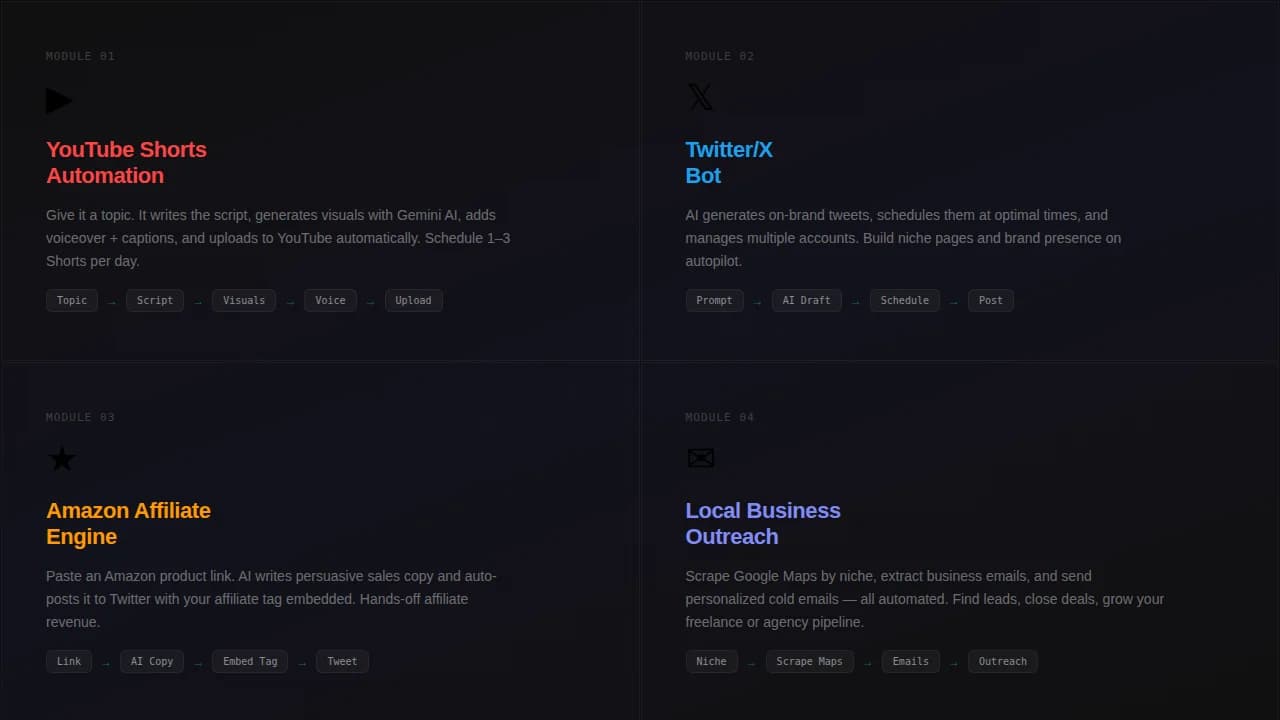
They mentioned three things that made the biggest difference. The first two were workflow changes — batching the creative work separately from the production work, and establishing fixed template structures so editing decisions were made once, not per video. The third was ShortFactory AI, which they described as an automated YouTube Shorts pipeline that handles the production layer entirely.
What stood out in their description: ShortFactory doesn't try to replace your voice or your ideas. It automates everything downstream of your core creative input. You feed in a topic or a hook, and the system handles scripting structure, caption generation, optimization copy (titles, descriptions, tags), and scheduling cadence. The production layer — which was consuming 80% of their time — becomes largely automated. The creative layer, which was 20% of their time and 100% of their value, expands to fill the space.
The net result: same creative output, 5x the publish frequency, and channel growth that compounds because the algorithm is finally getting what it needs to distribute the channel aggressively.
How the AI Shorts Production Pipeline Works
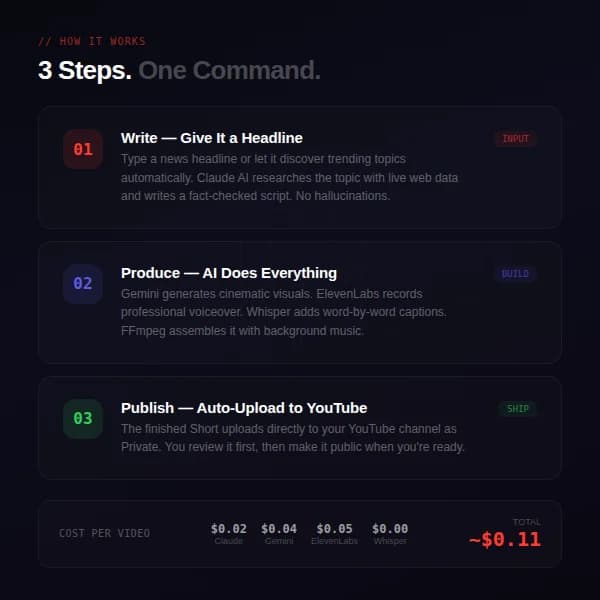
Step 1: Trend and Topic Intake The pipeline starts with signal gathering — trending topics in your niche, competitor content analysis, comment mining from your existing videos, and keyword data from YouTube search. This runs continuously in the background, surfacing a queue of validated topics you can work from rather than staring at a blank page every morning.
Step 2: Hook Generation Hooks are the single highest-leverage element in a Short. The first 2-3 seconds determine whether the algorithm counts a view. The pipeline generates 8-10 hook variations for each topic — different angles, different emotional triggers, different formats (question, contradiction, bold claim, story opening). You pick the one that resonates. The selection takes 90 seconds instead of 30 minutes.
Step 3: Script Scaffolding For each approved hook, the system generates a script scaffold: hook → tension/value delivery → resolution/CTA. This isn't a finished script — it's a structural framework you customize with your voice, your examples, your specific expertise. Cuts scripting time from 45 minutes to 10-15 minutes.
Step 4: Auto-Caption and Graphics Templates Captions, lower thirds, and graphic overlays are generated from the script scaffold and applied to your video template automatically. You're not manually placing text on a timeline. The visual production layer is templated and auto-populated.
Step 5: Optimization Package Generation Title variations, descriptions, hashtag sets, and keyword tags are generated for each Short based on your niche's current search landscape. You review and approve. This takes 3 minutes instead of 15.
Step 6: Scheduling and Publishing Approved Shorts are queued to your optimal posting schedule — typically one in the morning, one midday, one in the evening for maximum algorithmic surface area across time zones. The cadence is maintained even when you're not actively producing, because you've built a buffer in the pipeline.
The total creator time per Short, with this pipeline: 20-35 minutes, concentrated entirely on the creative decisions. The mechanical production time is effectively zero.
Frequently Asked Questions
Will AI-assisted Shorts hurt my channel's authenticity? Authenticity lives in your hook choices, your examples, your delivery, and your perspective — none of which AI replaces in this pipeline. What AI automates is caption formatting, title copywriting, tag selection, and scheduling. These are mechanical tasks that don't carry your voice anyway.
How many Shorts can one person realistically publish per day with an AI pipeline? Most creators using optimized AI pipelines report sustainable output of 3-5 Shorts per day. Beyond that, the creative input layer — idea selection, hook review, script customization — becomes a bottleneck. The goal isn't unlimited volume, it's sustainable daily frequency.
Does the YouTube algorithm actually penalize low-frequency Shorts channels? "Penalize" is too strong — YouTube doesn't actively suppress channels. But the distribution algorithm strongly favors channels with consistent posting signals. Channels that post Shorts daily receive significantly more recommended slot allocations than channels posting sporadically, even controlling for individual video performance metrics.
What kind of content works best with AI-assisted Shorts production? Educational content, how-to content, and opinion/commentary content work especially well because the script structure is highly repeatable. Entertainment-focused content that relies on spontaneous performance is harder to automate — the creative input stays high.
Will my Shorts look like everyone else's if I use the same production system? No — and this is a common misconception about AI production pipelines. The visual template is yours. The voice is yours. The topic angles are yours. The AI handles structural and mechanical consistency, not creative identity. Two creators using the same pipeline with different topics and different personalities produce entirely different content.
How long before an AI-optimized Shorts strategy shows results? Most creators see measurable algorithmic improvement — more consistent impressions, higher click-through rates on recommendations — within 30-60 days of daily posting. Subscriber growth compounds after 90 days of consistent frequency. The algorithm needs time to recalibrate its model of your channel.
What's the minimum setup for an AI-assisted Shorts pipeline? At minimum: a topic intake system, hook generation, script scaffolding, and a title/description generator. Caption automation and scheduling add significant leverage but are secondary. Start with the creative layers and add production automation progressively.
Conclusion
The Shorts algorithm is indifferent to your excuses. It doesn't care that you're busy, that editing is tedious, or that ideation is exhausting. It cares about frequency — because frequency is what it can measure, reward, and distribute.
The good news: frequency is no longer a talent question or a time question. It's an infrastructure question. And infrastructure problems have infrastructure solutions.
The creators building the most durable Shorts channels right now aren't the most creative. They're the ones who built a pipeline that makes daily output possible without daily suffering. That's the competitive moat they're building — and it compounds every day you're not building it.
References
- YouTube Shorts Monetization and Algorithm Analysis — YouTube Creator Academy
- Creator Economy Report 2024 — SignalFire
- Short-Form Video Consumption Trends — eMarketer
- Cognitive Load and Creative Production — Harvard Business Review