Mission Control, Artificial Intelligence and the Future of Design
Mission Control, Artificial Intelligence and the Future of Design
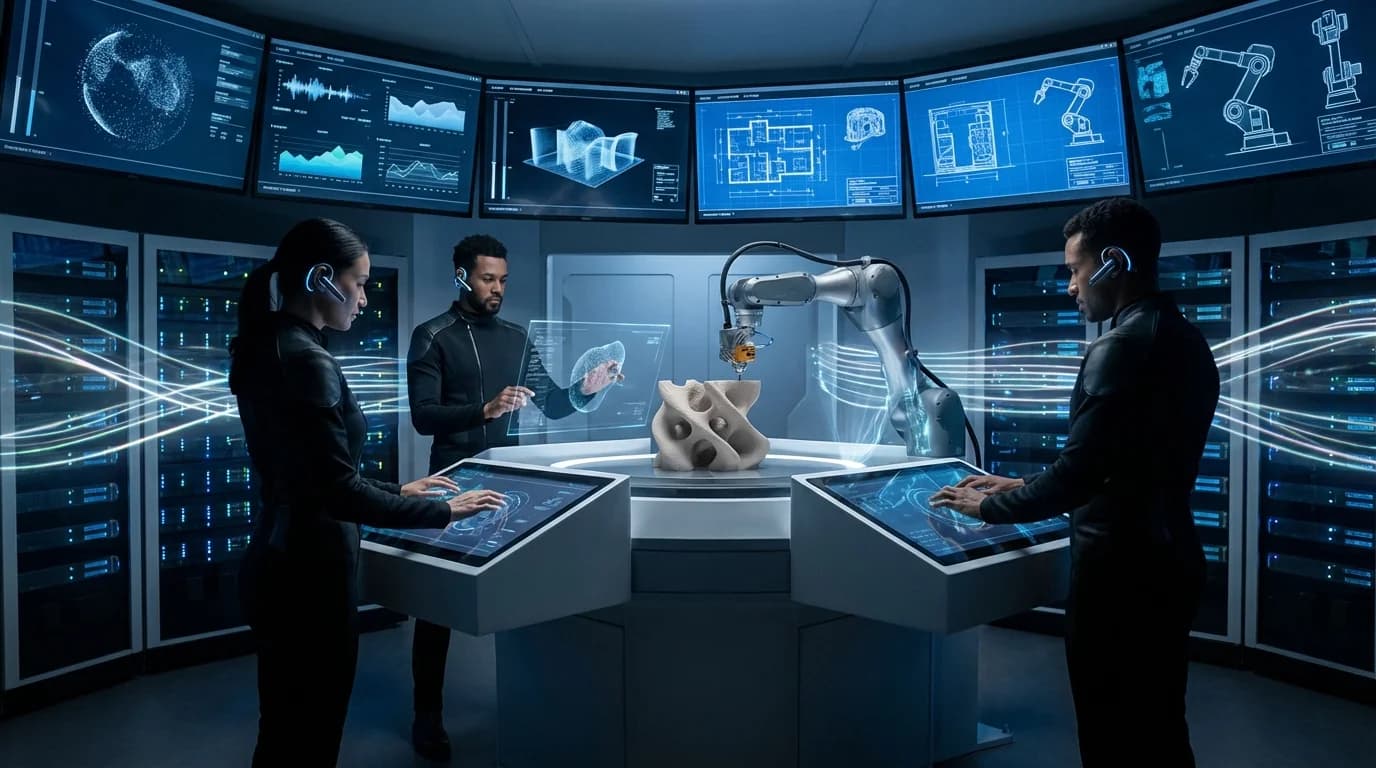
The Mission Control Metaphor In NASA's mission control, humans do not fly the spacecraft manually — computers handle the precision work. But humans make every consequential decision, interpret ambiguous situations and take responsibility for outcomes. This is exactly how AI should function in design: handling complexity and scale while human judgment directs the mission. Best suited for: design directors, creative leads, product designers and anyone thinking about where design practice is heading. Explore AI-Integrated Design →
The Modern Web Design team has been experimenting with AI-integrated design workflows since early 2023. Across 750+ projects, we have developed a clear picture of where AI creates genuine value and where it creates the illusion of value.
Table of Contents
- The Control Problem in AI-Assisted Design
- What AI Has Changed in Our Studio
- The New Design Skill Set
- AI and Creative Responsibility
- The Future Design Process
- What Stays Human
- Predictions for Design in 2026-2030
- Preparing Your Team for the AI Design Era
- Conclusion
The Control Problem in AI-Assisted Design {#control-problem}
The central challenge of AI in design is not capability — it is control. AI tools can generate a logo, write copy, build a layout and produce code. The question is: who is responsible for the quality, appropriateness and impact of that output?
The mission control model answers this clearly: the designer is always in command. AI is an instrument panel and autopilot system — incredibly capable within defined parameters, but never autonomous in consequential decisions.
Design is a discipline of intent. Every element communicates something to every user who encounters it. AI has no intent — it has pattern completion. The gap between pattern completion and intentional communication is where human designers earn their value.
The Autopilot Danger
Autopilot is most dangerous when pilots stop monitoring the situation and lose situational awareness. The same dynamic applies in design. Designers who delegate too much to AI lose the situational awareness that makes them effective when the unexpected problem arrives — and it always arrives.
What AI Has Changed in Our Studio {#what-changed}
What Genuinely Improved
- First-draft speed: Content structures, initial layout explorations and first-draft copy that took hours now take minutes.
- Variation generation: Exploring 20 visual directions before committing to one is now accessible, not prohibitively expensive.
- Code boilerplate: Component scaffolding, utility functions and repetitive patterns are faster with AI assistance.
- Research synthesis: AI is excellent at synthesizing research briefs, competitive analyses and user interview notes.
What Has Not Changed
- Strategic decisions: Which problem to solve, for whom, with what priority — these require human judgment and client context.
- Creative direction quality: AI-generated layouts need substantial human curation. Excellence still requires human elevation.
- Client relationships: Understanding what a client really means, managing expectations, navigating complexity — all human.
- Quality judgment: Knowing when something is good, not just technically correct — this remains distinctly human.
The New Design Skill Set {#new-skills}
Skills Becoming More Valuable
- Creative direction: Evaluating, curating and elevating AI outputs requires excellent taste and judgment
- Prompt engineering: Getting high-quality outputs requires knowing how to specify intent precisely
- Systems thinking: Designing the rules and patterns that govern AI-assisted output at scale
- Ethical reasoning: Deciding what AI should and should not do in specific design contexts
- Research and synthesis: Understanding users deeply enough to direct AI effectively
Skills Becoming Less Differentiating
- Technical execution at a pixel-perfect level
- Routine copy generation
- Basic layout generation
AI and Creative Responsibility {#creative-responsibility}
When AI generates a design element that performs well commercially but reinforces harmful stereotypes — who is responsible? The designer who used the tool. The agency that deployed it. The client who approved it.
The existence of the AI tool does not transfer responsibility. If you deploy it, you own the outcome.
Responsible Creative Practice
- Review all AI-generated content for representational bias before publishing
- Maintain a human in the quality-review loop for all public-facing outputs
- Document your AI governance policy
- When AI output is inappropriate, fix it — do not rationalize it as "just what the AI produced"
The Future Design Process {#future-process}
2025: Human-Directed, AI-Accelerated
Current state. Designers direct AI tools to accelerate execution. Quality requires significant human curation.
2026-2027: Collaborative Loops
AI systems that learn from designer decisions will create genuine bidirectional feedback. Not AI autonomy — AI that improves in response to human feedback.
2028-2030: Autonomous Execution with Human Oversight
AI agents execute complete design workflows within defined parameters. Human designers define parameters, review outputs and intervene in edge cases.
What Stays Human {#stays-human}
Meaning-Making
Design creates meaning — it makes intangible values visible, makes complex ideas accessible, makes emotional resonance possible. This requires human understanding of human experience.
Strategic Judgment
Deciding which problem is worth solving, for whom, at what cost — this requires values, context and responsibility that cannot be delegated.
Trust and Relationship
Clients hire designers, not tools. The trust relationship between designer and client is inherently human.
Accountability
When a design decision causes harm or fails commercially — a human is accountable. AI tools do not bear accountability.
Predictions for Design in 2026-2030 {#predictions}
1. Design tools will include AI agents as first-class features (Figma, Framer and successors). 2. The design team structure will change: fewer junior designers executing work, more senior designers directing AI. 3. The design-development gap will narrow as AI code generation from design files improves. 4. Personalization will become the expected standard on all consumer-facing products. 5. Original creative work will command higher premiums as AI makes average work cheap.
Preparing Your Team for the AI Design Era {#preparing}
For Design Leaders
- Develop your team's AI literacy — every designer should understand what AI can and cannot do
- Invest in quality judgment as a core team competency
- Build your AI governance framework now, before incidents force a reactive response
For Individual Designers
- Learn to work with AI tools proficiently — this is a baseline skill now
- Invest in the skills AI cannot replicate: research, strategy, relationships, taste
- Build a clear personal aesthetic — AI output is average; human creative direction is distinctive
For Clients and Organizations
- Invest in AI-integrated design teams — the productivity gains are real
- Do not eliminate human design oversight — quality risks of fully automated design are significant
- Develop clear policies on AI use in customer-facing content
Discuss AI-integrated design for your project →
Conclusion {#conclusion}
Mission control is the right metaphor for AI in design: humans in command, AI handling complexity, and the mission always defined by human intent and values. The most effective design teams are those that have embraced AI as a powerful tool while keeping human judgment firmly in the seat of authority.
References
- Google AI Overviews — Google
- Answer Engine Optimization Guide — Ahrefs
- Nielsen Norman Group — UX Research — Nielsen Norman Group
- Google Material Design — Google