ChatGPT for SEO: Does AI-Generated Content Actually Rank?
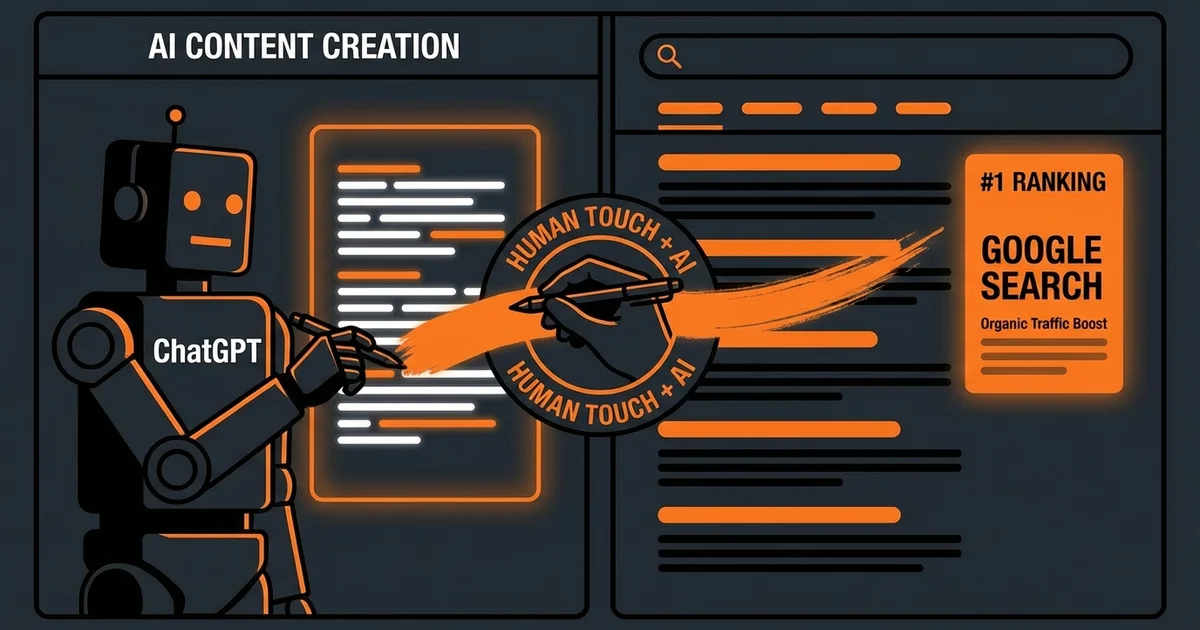
ChatGPT for SEO Content Creation: Does AI-Generated Content Actually Rank?
What is AI SEO Content Creation? AI SEO content creation uses models like ChatGPT to draft article outlines, sections and meta tags, then applies human expertise, original data and E-E-A-T signals to produce content that satisfies Google's Helpful Content policy. Used correctly, it speeds up production without sacrificing quality. Used incorrectly, it generates thin, repetitive text that Google actively demotes. Free Consultation →
The question every content team asks in 2026: can ChatGPT write content that ranks? The honest answer is yes — and no. The AI itself does not rank. Content that demonstrates real expertise, experience, authoritativeness and trustworthiness ranks. ChatGPT can accelerate the production of that content, but it cannot manufacture the signals that make it trustworthy.
This guide covers the exact workflow our team at Modern Web SEO uses to produce AI-assisted content that passes Google's quality filters, satisfies E-E-A-T requirements and drives organic traffic.
Table of Contents
- Google's AI Content Policy in 2026
- What E-E-A-T Means for AI Content
- Prompt Engineering for SEO
- AI Content vs Human Content: Key Differences
- Humanization Techniques That Work
- AI Detection and How to Handle It
- Fact-Checking and Source Verification
- Quality Signals Checklist
- Step-by-Step AI Content Workflow
- Frequently Asked Questions
- Conclusion
Google's AI Content Policy in 2026 {#google-policy}
Google's position has not changed since the Helpful Content Update: the origin of content (human or AI) is not the ranking factor. The quality is. Google's guidelines explicitly state that automatically generated content designed primarily to manipulate search rankings violates their spam policy — but AI content written to genuinely help users does not.
The practical implication: Google does not penalize content for being AI-generated. It penalizes content that lacks helpfulness, depth and accuracy — and AI content frequently fails those tests when published without human review.
The 2025 Search Quality Rater Guidelines reinforced that raters look for original reporting, first-hand experience and content that could not be found elsewhere. These are qualities ChatGPT structurally cannot provide without human input. Our SEO consulting service always layers human expertise on top of any AI-assisted drafts.
What E-E-A-T Means for AI Content {#e-e-a-t}
E-E-A-T stands for Experience, Expertise, Authoritativeness and Trustworthiness. Google uses these signals to evaluate content quality, and they are precisely where AI content falls short by default.
Experience means first-hand exposure to the topic. ChatGPT has none. You do. Adding case studies, personal anecdotes, specific project outcomes and original data transforms a generic AI draft into content with genuine experience signals.
Expertise requires demonstrating deep domain knowledge. AI can summarize publicly available knowledge but cannot synthesize original insights. Injecting proprietary frameworks, contrarian perspectives backed by evidence and technical depth that goes beyond surface-level information supplies expertise.
Authoritativeness is built through bylines, author bios with credentials, citations from authoritative sources and links from other authoritative sites. Every AI-assisted article needs a named human author with a verifiable online presence.
Trustworthiness comes from accuracy, transparency and citing sources. Fact-check every AI-generated claim. Link to primary sources. Disclose when and how AI was used in production.
| E-E-A-T Signal | AI Provides | Human Must Add |
|---|---|---|
| Experience | Nothing | Case studies, personal data |
| Expertise | Surface-level summaries | Original analysis, frameworks |
| Authoritativeness | No byline | Named author, credentials |
| Trustworthiness | Plausible-sounding text | Verified facts, citations |
Prompt Engineering for SEO {#prompt-engineering}
The quality of your ChatGPT output depends entirely on prompt quality. Vague prompts produce generic content. Specific, structured prompts produce usable drafts.
Effective SEO Prompt Patterns
The Role + Goal + Constraints Pattern:
Act as a senior [industry] expert writing for [target audience].
Goal: Write a 400-word section explaining [specific subtopic] for an article about [main topic].
Target keyword: [primary keyword]
Tone: Professional but direct, no filler phrases
Include: One specific example, one data point (note if fabricated)
Avoid: Passive voice, generic advice, vague claims
The Outline-First Pattern: Ask ChatGPT to produce a detailed outline first. Review and revise it before asking for section drafts. This prevents the AI from burying your target keyword in a section structure that does not serve your SEO goals.
The Persona-Injection Pattern: Provide your brand voice guidelines, past article excerpts and specific terminology preferences in the prompt. The more context you give, the less homogenization you get.
Prompt Patterns That Improve SEO Output
| Pattern | What It Does | When to Use |
|---|---|---|
| Role + Goal + Constraints | Grounds output in context | All drafts |
| Outline-first | Controls structure before content | New topics |
| Persona injection | Reduces generic tone | Brand content |
| Devil's advocate | Surfaces counterarguments | Opinion pieces |
| Data placeholder | Marks facts for verification | Technical posts |
| FAQ generation | Produces PAA-aligned questions | FAQ sections |
AI Content vs Human Content: Key Differences {#comparison}
Understanding the structural differences between AI and human content helps you identify exactly where to intervene.
AI content tends to be well-organized but shallow. It describes categories of a problem without solving specific instances. It uses balanced, hedging language ("it depends," "there are pros and cons") rather than taking informed positions. It lacks the specificity that comes from actually doing the thing being described.
Human expert content takes positions. It cites specific numbers from named studies. It acknowledges edge cases. It contradicts popular advice when evidence warrants it. It includes failure modes and warnings that only practitioners encounter.
The gap between AI drafts and publishable content is almost always a specificity gap. Your job as editor is to inject specificity at every level: specific tools, specific numbers, specific scenarios, specific outcomes.
| Dimension | Typical AI Output | Expert Human Content |
|---|---|---|
| Depth | Broad survey | Focused deep-dive |
| Specificity | General principles | Named tools, exact figures |
| Position | Balanced/hedged | Informed, defensible |
| Experience | None | Explicit first-hand examples |
| Originality | Recombined public data | Novel insights |
| Accuracy risk | High (hallucinations) | Lower (known domain) |
Humanization Techniques That Work {#humanization}
Humanizing AI content is not about defeating AI detectors. It is about adding the substance that makes content genuinely useful. When you do that well, AI detectors become irrelevant — the content has the markers of human expertise because it actually contains human expertise.
Add the "only you know this" layer. After each AI section, ask: what do I know about this topic that is not in the AI's training data? Insert that knowledge as a specific paragraph or callout.
Replace vague examples with real ones. AI examples are fictional composites. Replace them with actual client scenarios (anonymized if needed), real tool names and real outcomes.
Insert friction and nuance. Expert content acknowledges that approaches sometimes fail. Add a "When this does not work" subsection to how-to guides.
Use first person strategically. "In our experience" and "we found that" are legitimate signals of real-world exposure. Use them when they are accurate.
Rewrite the opening. AI introductions are almost always formulaic. Write your own hook — start with a specific claim, a counterintuitive fact or a direct statement of what the article proves.
AI Detection and How to Handle It {#ai-detection}
Tools like GPTZero, Originality.ai and Copyleaks attempt to identify AI-generated text. Google has stated it does not use AI detection in its ranking systems — it uses quality signals. But some publishers, clients and editorial teams do use these tools.
The most reliable way to pass AI detection is to add so much genuine human content that the AI contribution becomes a minority of the final text. If your final article is 30% AI draft and 70% human rewrite, revision and addition, detection becomes unreliable regardless of which tool is used.
A secondary technique is syntactic variation: AI tends toward consistent sentence length and predictable clause structures. Manually vary your sentence lengths, mix short punchy statements with longer analytical ones, and break up parallel list structures with prose paragraphs.
Fact-Checking and Source Verification {#fact-checking}
ChatGPT hallucinates — it generates plausible-sounding statistics, quotes and citations that do not exist. This is not a feature that will be fixed; it is structural to how language models work. Every factual claim in an AI draft must be verified before publication.
Build a fact-checking step into your workflow:
1. Highlight every numerical claim in the AI draft. 2. Search for the original source of each claim (Google Scholar, industry reports, official documentation). 3. Replace unverifiable claims with verified alternatives or remove them. 4. Link to primary sources — this simultaneously verifies accuracy and builds trustworthiness signals.
Common hallucination categories to watch: percentage statistics, named study authors and years, software version numbers and feature availability, legal and regulatory claims, and historical dates.
Quality Signals Checklist {#quality-signals}
Before publishing any AI-assisted article, run it through this checklist:
- [ ] Every numerical claim has a linked source
- [ ] Named author with bio and credentials is attached
- [ ] At least one first-hand example or case study is present
- [ ] The article takes a defensible position on the topic
- [ ] Target keyword appears in title, H1, first 100 words and at least two subheadings
- [ ] Internal links to at least 5 relevant pages on your site
- [ ] External links to at least 3 authoritative primary sources
- [ ] Images have descriptive alt text
- [ ] Reading level is appropriate for target audience
- [ ] FAQ section addresses real user questions (from Google PAA, Search Console queries)
Step-by-Step AI Content Workflow {#how-to}
This is the production workflow our team uses for AI-assisted SEO content at Modern Web SEO.
Step 1: Keyword and intent research. Before opening ChatGPT, know your target keyword, the search intent (informational, commercial, navigational), the top 5 ranking pages and what angle is missing from existing results. This research shapes every prompt decision.
Step 2: Create a human-written outline. Draft your own outline based on keyword research and competitor analysis. Do not let AI determine your content structure — that is where your SEO strategy lives.
Step 3: Generate section drafts with specific prompts. Use the Role + Goal + Constraints pattern for each section. Generate sections individually rather than asking for a full article — individual sections are easier to control and review.
Step 4: Fact-check every section immediately. Do not accumulate unverified claims. Check each section as it comes out of the model.
Step 5: Add the human layer. Go through each section and add first-hand experience, specific examples, original data and your expert position. This step should take as long as the AI generation step, at minimum.
Step 6: Write the introduction and conclusion yourself. These are the most voice-defining parts of an article. Always write them from scratch.
Step 7: Internal linking and technical SEO. Add internal links to relevant pages on your site. Our blog, services and packages pages provide natural linking targets for most SEO topics.
Step 8: Final quality review. Read the full article aloud. Anything that sounds stilted, vague or mechanical needs rewriting.
Get expert content production support →
Frequently Asked Questions {#faq}
Will Google penalize my site for using ChatGPT to write content? Google does not penalize content for being AI-generated. It penalizes content that is unhelpful, thin or manipulative. If your AI-assisted content meets the quality bar for Experience, Expertise, Authoritativeness and Trustworthiness, it will not be penalized. The key is treating AI as a drafting assistant, not a publishing pipeline.
What is the best ChatGPT model for SEO content in 2026? GPT-4o and Claude 3.5 Sonnet produce the most coherent long-form content as of 2026. Model selection matters less than prompt quality and post-generation editing. Use whichever model your team is most comfortable prompting and reviewing.
How do I add E-E-A-T to AI-generated content? Add a named author with a bio and verifiable credentials. Insert first-hand case studies and specific project outcomes. Fact-check and link to primary sources. Take clear positions rather than hedging. These actions supply E-E-A-T signals regardless of whether the initial draft was AI or human-written.
Can AI-generated content rank for competitive keywords? Yes, if it is the best answer for the searcher's intent. Competitive keywords require content that goes beyond what existing pages cover — original data, novel frameworks, deeper technical explanations. AI alone cannot supply this; it requires significant human input. For moderately competitive keywords, well-edited AI content can rank.
How often does ChatGPT hallucinate facts? Studies suggest GPT-4 fabricates approximately 20% of specific factual claims in long-form content — a rate high enough to require systematic fact-checking of every article. Hallucination rates are higher for obscure topics and lower for well-documented mainstream subjects.
Should I disclose AI use in my articles? Google does not require disclosure, but transparency builds reader trust. Consider a brief author note mentioning that AI tools assisted in the drafting process. Several major publishers now include this as standard practice. Our about page explains our content production philosophy.
What is the difference between AI content and thin content? Thin content is content that provides little value relative to the searcher's need — short pages, duplicate pages, pages that aggregate content without adding insight. AI content can be thin or substantive depending on production quality. The distinction that matters to Google is helpfulness, not origin.
How do I use ChatGPT for meta title and description optimization? Prompt: "Write 5 meta title variations for a page about [topic]. Target keyword: [keyword]. Max 60 characters. Include a benefit and avoid clickbait." Then test CTR in Google Search Console by comparing impressions to clicks before and after switching titles. Meta descriptions should include the keyword, a value proposition and a call to action in 155 characters.
Conclusion {#conclusion}
ChatGPT accelerates SEO content production significantly. It does not replace the judgment, experience and credibility that make content rank for competitive queries. The workflow is: AI drafts the structure and surface content, human expertise provides the depth, specificity and trustworthiness that Google rewards.
Treat every AI article as a 50% complete draft that needs your domain knowledge to become publishable. When you do that consistently, AI assistance becomes a genuine productivity multiplier without compromising quality.
Our team at Modern Web SEO produces content that combines AI efficiency with genuine SEO expertise. See our services, portfolio and packages to learn how we can support your content strategy.
| Related reading: Technical SEO Services | SEO Packages | About Our Team |
|---|