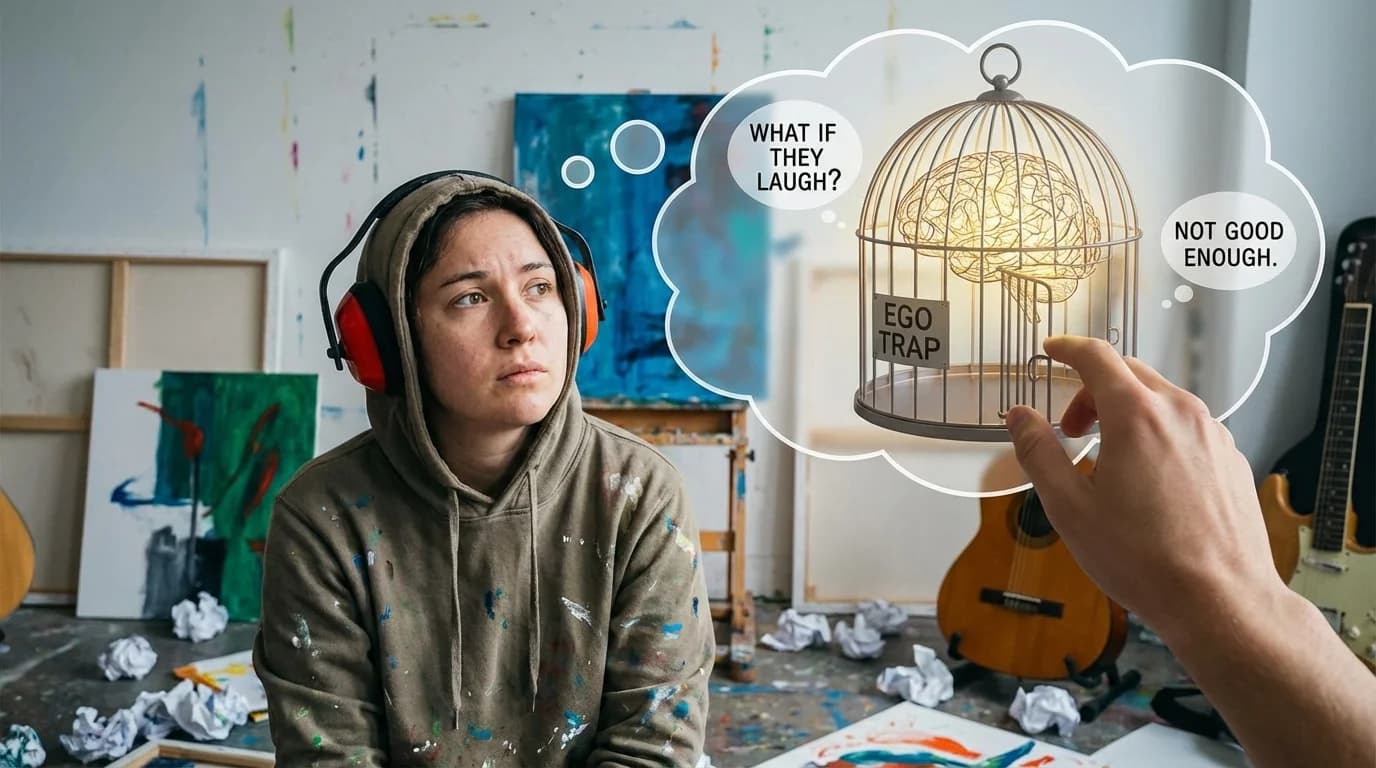
Embracing Looking Dumb: The Real Defensive Power in Creative Work

Embracing Looking Dumb: The Real Defensive Power in Creative Work
The Paradox at the Heart of Creative Excellence The designers, writers and makers who produce the most original work have something unexpected in common: they are all comfortable — sometimes aggressively comfortable — with appearing foolish. This is not a personality quirk. It is a strategic choice with compounding returns. Best suited for: creative professionals, design leaders, founders and anyone building a practice of original thinking. Build Something Original With Us →
This essay is a companion to our piece on the fear of looking dumb. Where that piece examined the problem, this one makes the affirmative case: looking dumb in creative work is not a side effect to tolerate — it is a capability to cultivate.
Table of Contents
- The Strategic Case for Looking Dumb
- Looking Dumb as a Learning Accelerant
- Looking Dumb as Originality Insurance
- Looking Dumb as a Status Signal
- Looking Dumb in Cross-Disciplinary Work
- The Accumulated Courage Model
- How to Practice Looking Dumb
- Looking Dumb in Client Relationships
- The Long Game: A Career Built on Creative Courage
- Conclusion
The Strategic Case for Looking Dumb {#strategic-case}
There is a class of competitive advantages that are paradoxical — they work precisely because they appear to be disadvantages. Looking dumb in creative contexts is one of them.
Most practitioners optimize for appearing competent: they present finished work, confident positions and expert opinions. They self-censor anything that might undermine their professional image. They converge on established conventions because conventions are defensible.
The creative professional who opts out of this image management gains access to a different competitive space: ideas too risky for everyone else to propose, questions that reveal blindspots everyone else is protecting, experiments everyone else declined to run.
When everyone else is protecting their image, the person who is not protecting their image has access to the entire creative space. The people guarding their reputations have surrendered most of that space voluntarily.
This is the strategic case for looking dumb: it is a form of competitive arbitrage available to anyone willing to pay the social cost.
Looking Dumb as a Learning Accelerant {#learning}
Knowledge compounds. The person who learns 10% faster than a peer, over a decade, ends up in a dramatically different place.
The Ask/Not-Ask Dynamic
Every time a professional declines to ask a question to protect their image, they receive no new information. Every time they ask the "dumb" question, they receive information — either the answer, or confirmation that the question was obvious (which costs nothing).
The asymmetry is stark: the cost of asking and appearing unknowledgeable is small and temporary. The cost of not asking and remaining unknowledgeable is large and compounding.
The Feedback Loop
The person who shares rough work early receives feedback early. They iterate. The person who waits until work is "ready" before sharing receives feedback late, when changes are costly.
Looking dumb by sharing unfinished work is a feedback compression mechanism. Over a career, this compresses into significantly more iterations — and iterations, not talent, are the primary mechanism of creative excellence.
The Expert Interview Advantage
Most creative professionals are reluctant to approach domain experts with naive questions. The practitioners who adopt deliberate naivety in expert interviews gain access to information that self-styled experts cannot access (because they cannot admit they do not know). The dumb question surfaces the insight no one has been willing to ask.
Looking Dumb as Originality Insurance {#originality}
Originality requires departure from convention. Convention is, by definition, what the majority recognizes as correct. Departing from convention means proposing something the majority will not initially recognize as correct — meaning it will look wrong. Looking wrong in a domain of expertise looks dumb.
There is no path to consistent originality that does not pass through consistently looking dumb. The willingness to look dumb is the precondition for originality.
The Convention Trap
Conventions exist because they work. This is a trap: they are easy to default to, defensible, and produce acceptable outcomes. But acceptable outcomes are not the outcomes that build reputations, win awards or change industries.
The First-Mover Premium
The first person to propose a genuinely original idea will often face skepticism. If they persist and the idea has merit, they will be recognized as the originator. If they retreat to protect their image, someone else will propose the same idea later — and receive the credit.
Looking Dumb as a Status Signal {#status}
Counter-intuitively, deliberate willingness to look dumb signals high status in creative communities, not low status.
High-status creative professionals can afford to look dumb. They have enough accumulated credibility that a single instance of apparent foolishness does not threaten their standing. When a senior designer asks a naive question, it reads as humility and intellectual curiosity — both high-status signals.
Low-status creative professionals cannot afford to look dumb. They compensate by projecting unearned expertise — which is immediately visible to observers and undermines their credibility further.
Building the Credibility Reserve
Building real expertise creates the reserve that makes looking dumb safe. At Modern Web Design, our 750+ project portfolio and 97 Lighthouse score average is the credibility reserve that allows us to tell clients "we don't know if this will work — let's test it" rather than projecting false certainty.
Looking Dumb in Cross-Disciplinary Work {#cross-disciplinary}
Cross-disciplinary work is inherently a posture of deliberate naivety. You will ask questions that domain experts find obvious. You will propose ideas that have already been tried. You will misuse terminology.
And you will bring the fresh perspective that insiders cannot bring, precisely because you have not spent years learning why certain things cannot work.
Application to Web Design
Some of our most effective UX solutions have come from applying frameworks from non-design domains:
- Onboarding flows designed using learning science principles
- Information architecture informed by library science and taxonomy theory
- Persuasion design informed by behavioral economics research
These cross-domain applications required being willing to be a naive outsider. The ideas they produced were not available inside the conventional UX design canon.
The Accumulated Courage Model {#courage-model}
Creative courage is not a static trait — it accumulates or depletes based on experience.
How Courage Accumulates
Every time you look dumb and the outcome is survivable — which it almost always is — you update your threat model. The evidence accumulates that looking dumb does not destroy careers. This is an exposure therapy model: each exposure reduces the fear response slightly.
How Courage Depletes
Creative environments that punish dumbness — through mockery or harsh criticism of early-stage ideas — deplete creative courage. The practitioners in these environments gradually narrow their creative range to the defensible, producing consistently acceptable and consistently forgettable work.
This is why creative culture is a strategic investment. The culture that creates conditions for creative courage directly determines the quality ceiling of creative output.
How to Practice Looking Dumb {#practice}
Daily Practice: The Five Naive Questions
Each day, identify one domain where you have expertise and ask yourself five questions a complete novice might ask. Not rhetorical — actual questions you would need to think carefully to answer.
Weekly Practice: The Rough Work Share
Each week, share one piece of work that is not finished. Build the habit of external feedback before the ego becomes invested in the current direction.
Monthly Practice: The Stupid Idea Review
Review ideas you have had and not shared in the past month. For each one, ask: why did I not share this? Was it actually a bad idea, or was I protecting my image?
Project Practice: The Pre-Mortem
Before beginning a significant project, imagine it has failed and ask "why did it fail?" This surfaces concerns that ego protection would otherwise suppress.
Looking Dumb in Client Relationships {#client-relationships}
Agencies often present polished confidence to clients — if they do not know something, they find out offline. This protects short-term image at the cost of long-term relationship quality.
The Transparency Advantage
Clients who experience an agency's genuine uncertainty — "we're not sure which approach will work better; let's test both" — often develop higher trust than clients who receive only polished certainty. The certainty feels performed; the uncertainty feels honest.
When the agency acknowledges what it does not know, the client contributes expertise — and the outcome is better.
Calibrated Confidence
The goal is calibrated confidence: confident where evidence and expertise support confidence, genuinely uncertain where they do not. The client can tell the difference, and calibrated confidence is more trustworthy than uniform confidence.
Experience a transparent design partnership →
The Long Game: A Career Built on Creative Courage {#long-game}
The case for creative courage is ultimately a compounding returns case.
Every creative risk that does not destroy you makes you slightly more capable of taking the next one. Every naive question teaches you something. Every piece of rough work shared generates feedback that makes the next iteration better. Every dumb idea proposed contributes to the volume of ideas from which breakthroughs emerge.
The Reputation You Are Actually Building
The fear is that looking dumb will damage your reputation. The reality is that consistently taking creative risks builds a reputation for originality and genuine expertise that is far more valuable than a reputation for appearing consistently competent.
Appearing consistently competent is the reputation of a safe choice. Being consistently creative is the reputation of an irreplaceable one.
Conclusion {#conclusion}
Embracing the willingness to look dumb in creative work is a deliberate strategic choice to access the creative space that ego protection forecloses.
The creative professionals who build careers on genuine originality, deep learning and authentic relationships have all paid the social cost of looking dumb regularly — and found that the cost is far lower, and the return far higher, than the ego predicted.
At Modern Web Design, we bring this posture to our work: willing to propose ideas before they are polished, ask questions before we know the answers and try approaches before we know they will succeed. 750+ projects later, the evidence suggests this approach produces better work than the alternative.