Fear of Looking Dumb in Creative Work: Escaping the Ego Trap
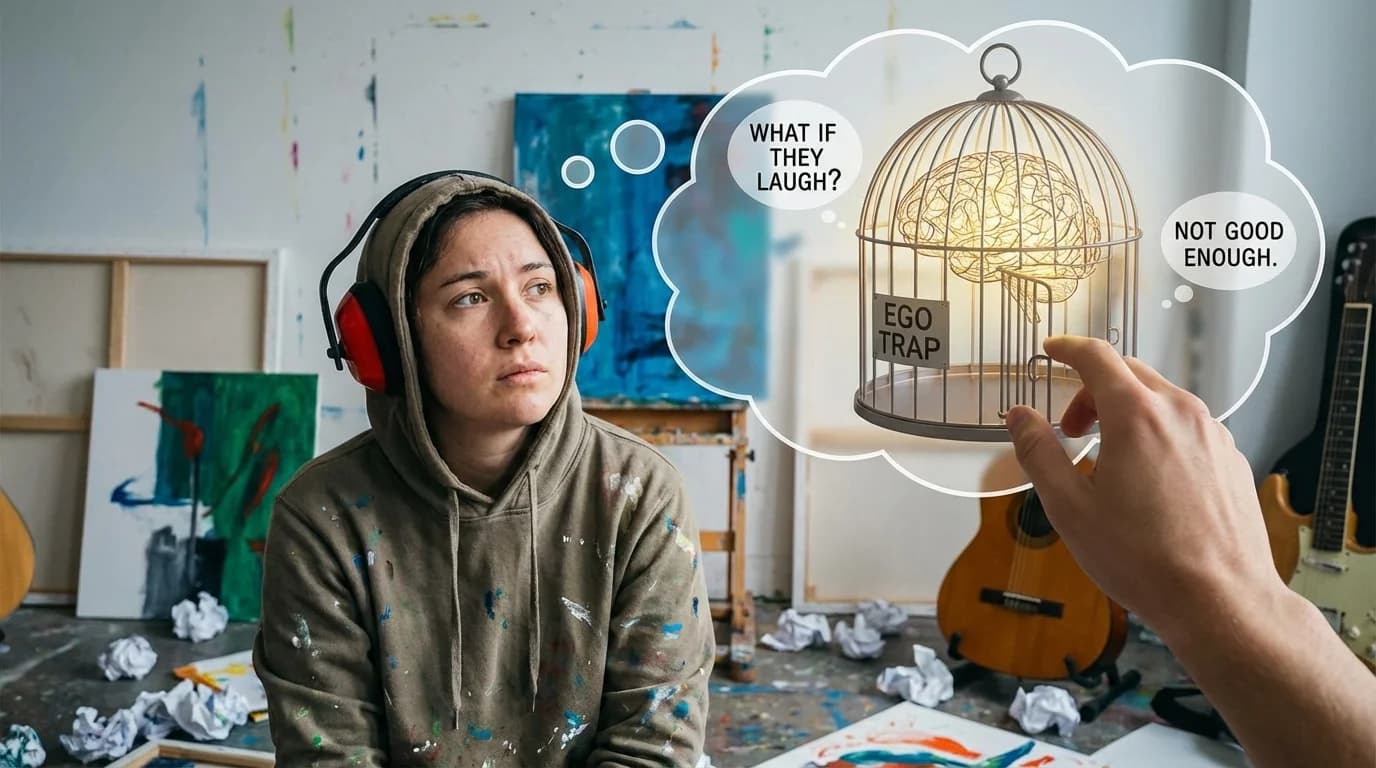
Fear of Looking Dumb in Creative Work: Escaping the Ego Trap
The Uncomfortable Truth The most creative work you will ever do requires you to say something you are not sure about, try something that might fail publicly and ask a question that exposes what you do not know. The ego will resist all of these. The ego is the enemy of creativity. Best suited for: designers, writers, founders, creative directors and anyone whose work involves generating original ideas. Work with a Team That Embraces Creative Risk →
At Modern Web Design, we have noticed a pattern across 750+ projects: the clients and teams that produce the most distinctive, effective creative work are the ones most comfortable with uncertainty and apparent failure during the process.
Table of Contents
- The Ego Protection Mechanism
- How Fear of Dumbness Manifests in Creative Work
- The Dumbness Dividend
- Why "Looking Dumb" Is the Gateway to Originality
- Practical Strategies for Creative Courage
- The Team Culture Question
- What Clients Can Do
- A Personal Framework
- Conclusion
The Ego Protection Mechanism {#ego}
The human brain is a prediction machine with an extensive self-protection subsystem. It monitors social status constantly, scanning for threats to our standing in the group. For most of human evolutionary history, social exclusion was genuinely life-threatening.
This protection mechanism fires with the same urgency whether the threat is social exclusion from a tribal group or a colleague saying "I don't think that idea works."
The result: we protect our self-image by not saying the thing that might be wrong, not proposing the idea that might be rejected, not asking the question that would reveal ignorance. We default to safe, familiar, defensible creative choices.
Safe, familiar, defensible creative choices produce forgettable work.
How Fear of Dumbness Manifests in Creative Work {#manifestations}
The Expert Trap
The more expert you become, the higher the stakes of appearing non-expert. Beginners ask obvious questions freely — they have no reputation to protect. Experts ask fewer questions because the cost of revealing ignorance is higher.
This is why senior designers sometimes produce less original work than junior designers: they have accumulated an inventory of approaches that work, and the risk/reward calculation increasingly favors reusing proven approaches.
The Consensus Retreat
In design critiques, the first person to express an opinion sets an anchor. Others calibrate their contributions relative to that anchor. Genuinely divergent ideas — the ones that might produce something original — are self-censored because they risk social friction.
The Revision Spiral
Fear of dumbness creates perfectionism spirals: the designer who refines endlessly because sharing rough work might make them look unfinished. The founder who delays the launch because the product is not quite ready. This is ego protection wearing the costume of quality control.
The Dumbness Dividend {#dividend}
There is a compounding return to regularly looking dumb:
You learn faster. The person who asks the obvious question gets the obvious answer. The person who does not ask, to protect their image, learns nothing.
You get better ideas. The ideas you censor to protect your image are often the most original ones. They feel risky because they are unfamiliar. Unfamiliarity is not the same as wrongness.
You build genuine trust. Willingness to look dumb builds deeper trust than projecting expertise. "I don't know" signals that your confident statements can be believed.
You escape the expert trap. Cross-domain naivety produces some of the most original creative breakthroughs.
Why "Looking Dumb" Is the Gateway to Originality {#originality}
Every original idea looks dumb before it works.
The flat interface looked dumb when everything was beveled. Single-page websites looked dumb when everything was multi-page. Dark mode looked dumb when everything was light.
The ideas that become obvious in retrospect always look non-obvious in prospect. The dumbness signal is often an originality signal.
The Quantity Principle
Research on creative output consistently shows that the most original work comes from people who produce the most work overall. More attempts means more failures — and more failures means the occasional breakthrough.
Practical Strategies for Creative Courage {#strategies}
1. Separate Generation from Evaluation
Brainstorming works when generation and evaluation are separated. During generation, no idea is wrong — volume is the goal. During evaluation, judgment applies.
Try: 15-minute timed generation sessions with explicit "no evaluation" rules. Then spend 15 minutes evaluating.
2. The "Worst Idea" Warm-Up
Before a creative session, ask every participant to share their worst idea for the problem. This sets permission to be wrong and often produces useful creative starting points.
3. Label the Uncertainty
Instead of pretending confidence, label uncertainty explicitly: "This might be wrong, but..." This signals intellectual honesty, not weakness.
4. Seek Dissatisfaction
The ideas most worth pursuing are often the ones that leave you with slight dissatisfaction — a feeling that something is not quite right yet. This is a signal of originality in progress, not failure.
5. Create a "Stupid Ideas" Repository
Keep a running document of ideas too dumb to share. Review it monthly. With distance, some "stupid" ideas reveal unexpected merit.
The Team Culture Question {#team-culture}
Individual creative courage is necessary but not sufficient. The team culture determines whether individual courage is rewarded or punished.
Teams with psychologically safe cultures significantly outperform teams without this safety (Google's Project Aristotle research).
Building a Culture That Rewards Creative Risk
- Leaders must model creative risk-taking
- Critique the work, not the person
- Celebrate brave ideas that did not work
- Create explicit spaces for rough work — "work-in-progress" reviews where unfinished thinking is expected
What Clients Can Do {#clients}
Clients who signal "I want the most original solution, even if some attempts fail" expand creative exploration. Clients who signal "I need to appear decisive and expert" constrain it.
For Clients Working with Creative Teams
- Share genuine constraints and real problems, not pre-formed solutions
- Evaluate creative work against the problem, not your initial expectations
- Recognize that your discomfort with an idea may be a signal of its originality, not its wrongness
A Personal Framework {#framework}
When the fear of looking dumb arises:
1. Name it: "I'm not proposing this because I'm afraid it'll look stupid." Naming the mechanism partially disarms it. 2. Evaluate the actual risk: What is the worst realistic outcome? Usually: someone thinks it does not work, the idea is rejected, and work continues. 3. Ask the upside: What is the best realistic outcome? 4. Propose it as a hypothesis: "Here is an idea I'm not sure about. It might not work, but: [idea]." 5. Detach from the outcome: A rejected idea does not make you a bad designer. A hundred rejected ideas might make you a great one.
Conclusion {#conclusion}
The best creative work requires creative courage — the willingness to propose ideas before they are polished, ask questions before you are ready and try approaches before you know they will work.
At Modern Web Design, we would rather propose ten ideas that might not work in pursuit of the one that changes everything than deliver five safe, defensible, forgettable solutions.